
Board · Agents
A board for you and your agents.
Cards move from Backlog to Done. An agent can claim one, report progress, ask you when it’s stuck, and hand it back for review. Distill turns a spec into work that waits for itself.
A private memory for your Mac
Binders turns what you say, hear, and write into notes, to-dos, and answers—then keeps the whole thing on the Mac you already trust. No account. No cloud of ours.
Free and open source · macOS 14.2 or later · Signed and notarized by Apple
Why Binders
Your work is already spread across calls, notes, chats, and the files on your Mac. Binders gives it one private shape: what you said, heard, wrote, promised, and finished. Ask it a question, hand a piece of work to an agent, or open the board and see what’s next.
Dictation, meeting notes, writing capture, and all-day capture collect the work as it happens, without asking you to switch apps.
People, projects, decisions, and sources stay linked, so a question can travel from a name to everything they were part of.
Promises become to-dos, notes become cards, and a board lets you and your agents move the work forward together.
The workflow
You talk through an idea. Binders turns it into a spec, distills the work, and hands the cards to agents that pick them up, report back, and ask when they’re stuck. You keep the decisions.
Let’s make the pricing page show annual plans with a 15% discount, and add a comparison table. We should be ready by Friday.
Distill reads the spec and proposes cards. Nothing is created until you say so.
Should annual plans show the 15% discount in the table, or only on the pricing page itself?
Cursor is finishing the table. The page is ready to ship.
Pricing page · annual plans live with the 15% discount.
Speak · A product idea, said out loud.
A fictional demo. The note, cards, agents and product use the same demo data as the screenshots.
What it does
A small set of tools that share the same context, so a promise in a message can become a card on a board, and a meeting can answer a question weeks later.
Cards move from Backlog to Done. An agent can claim one, report progress, ask you when it’s stuck, and hand it back for review. Distill turns a spec into work that waits for itself.
Speech and AI run on your Mac. No account, no analytics, no cloud of ours. Your files are yours, in a folder you can open.
Hold fn, talk, let go. Clean text arrives in any app, and Command Mode can rewrite, answer, or add a to-do.
Both sides of the call, a summary, decisions, and action items with owners. The transcript stays searchable.
Writing capture turns the commitments you send into tasks with deadlines—without recording keystrokes.
Search by meaning across meetings, notes, and messages. Answers come with their sources, and a graph links the people and projects behind them.
Turn the day into captures, promises, and cards. Audio stays on the device that heard it.
Share a binder through a folder you already sync.
Let your AI tools search, ask, and work from your boards.
Run a Shortcut, open a URL, or call a web hook.
GPLv3, on GitHub, with the code behind every claim.
Inside Binders
The app is the product. Here is what it looks like when the day is moving: the work that needs you, the card where it gets done, and the notes that remember how you got there.
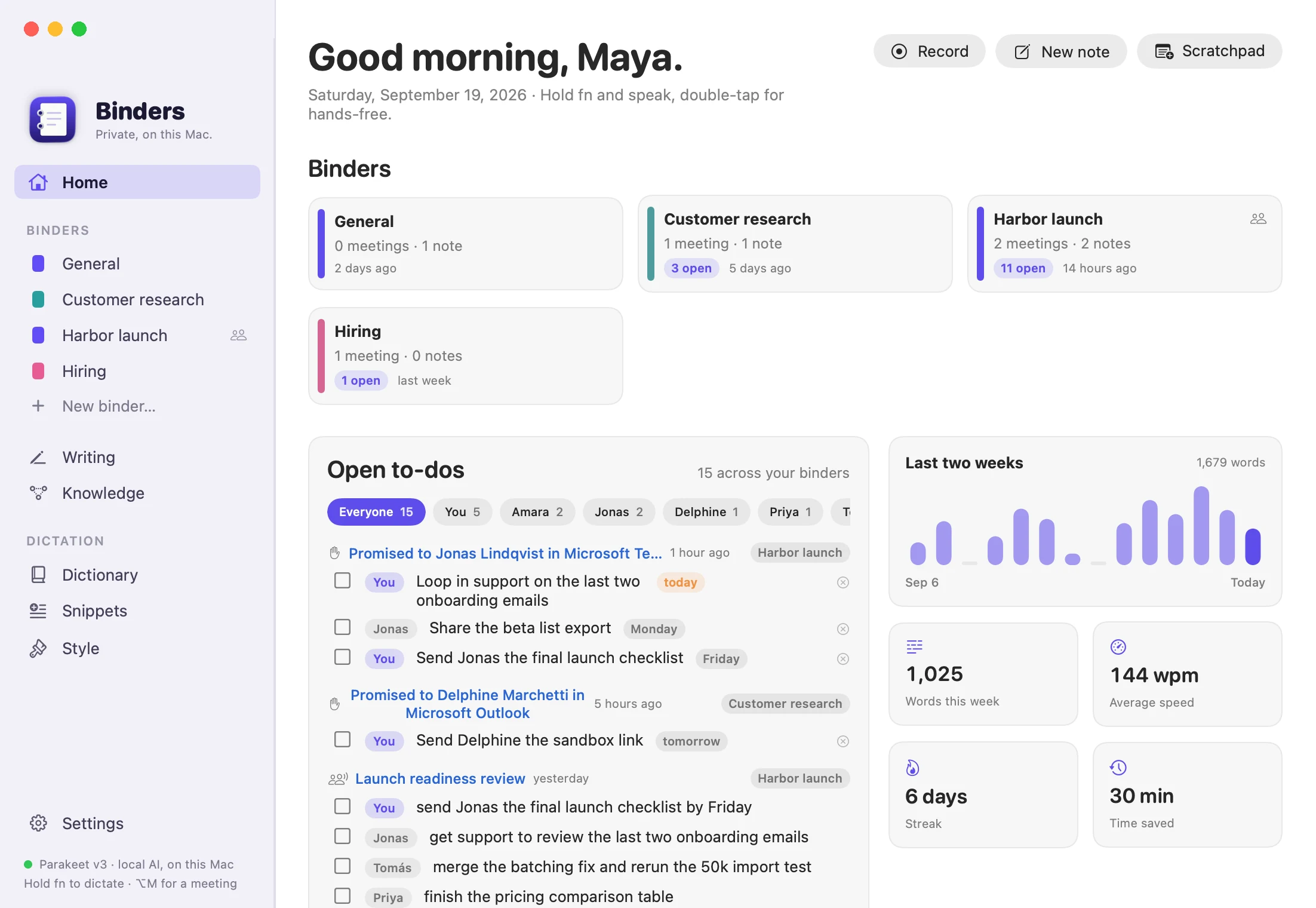
Home gathers what needs you: questions from agents, cards ready to check, open to-dos, and the day’s meetings.
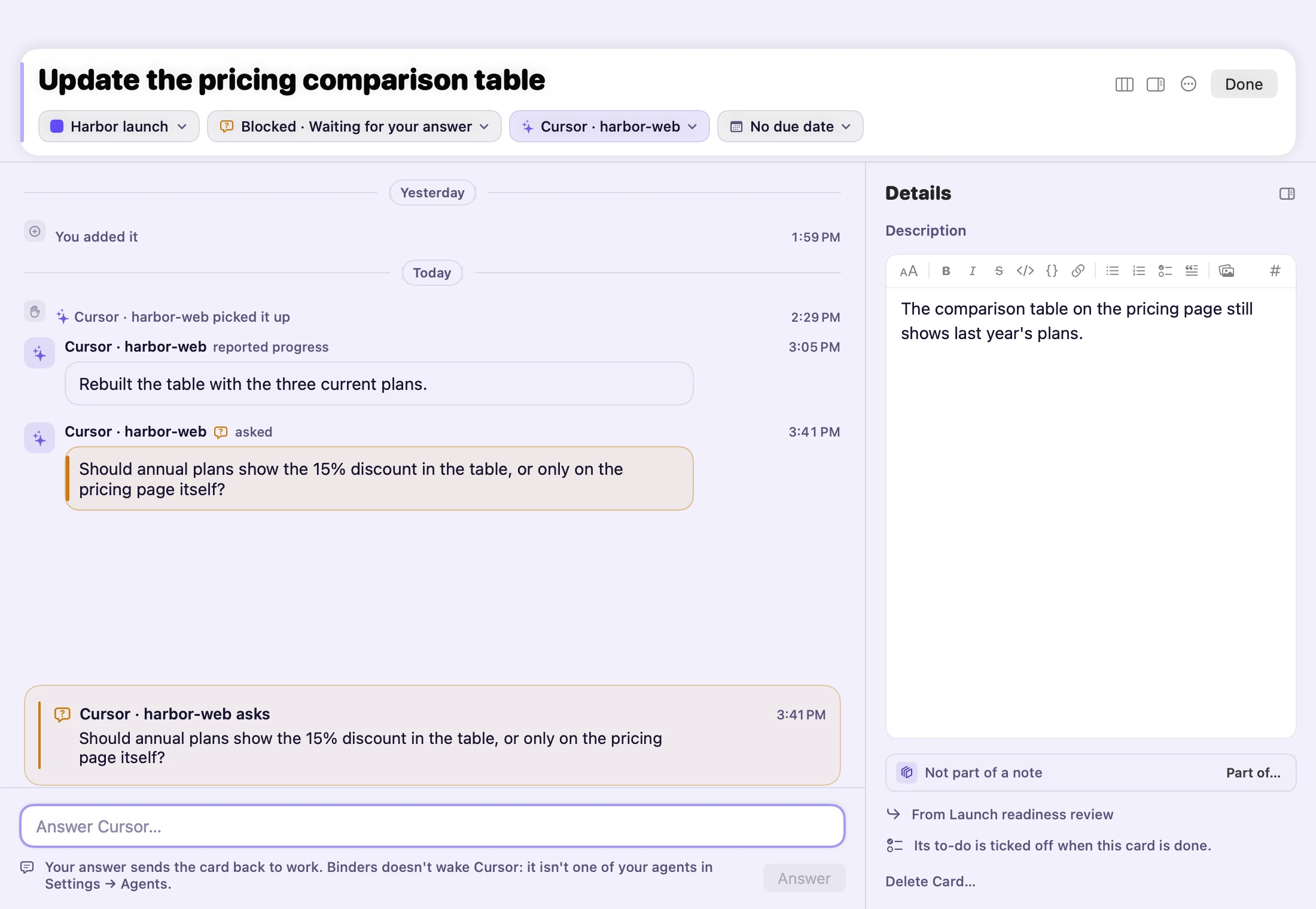
A card is a conversation with whoever does the work. An agent reports, asks, and hands it over; you approve or send it back.
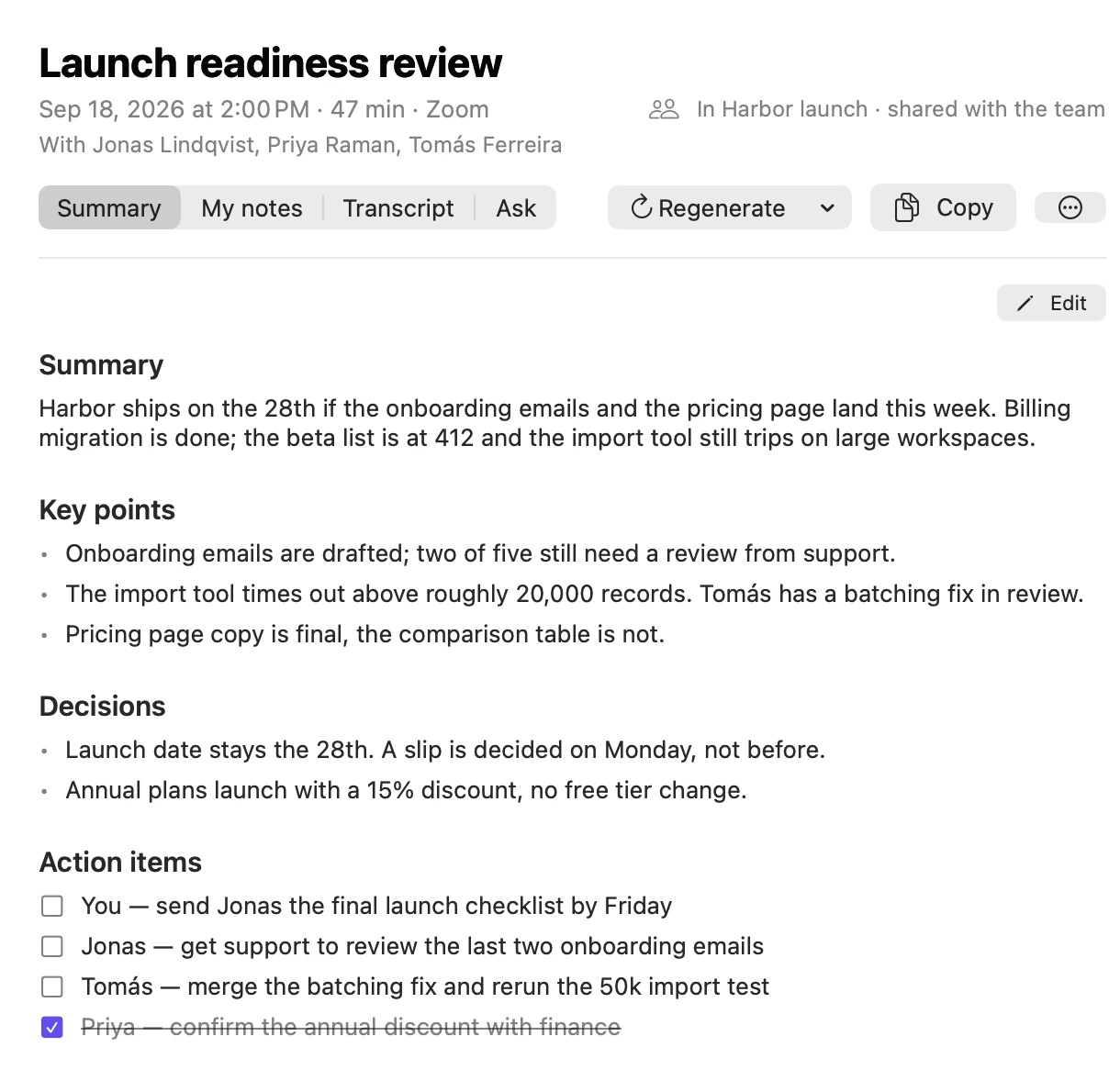
Meeting notes arrive with a summary, decisions, and action items by owner, plus a transcript you can ask.
Every person and project in these pictures is fictional.
Watch the 54-second tour No soundPrivacy
Binders has no account, no analytics, and no cloud of ours. The speech models and the language model run on your Mac; the files sit in a folder you can open. Here is exactly what stays, and what leaves only when you point it somewhere.
Open source · GPLv3
Free, open source, on your Mac
No account, no subscription, no trial clock. Binders runs on your Mac, so there is no server for anyone to pay for.
Download Binders 0.11.0 for MacVersion 0.11.0 · macOS 14.2 or later · Apple silicon recommended · Signed and notarized by Apple
Release notes · Help with setup · Read the code
SHA-256 e43f7284ee9addbc65e28ee51b72f4763d29cce26e1bdef269ead49ad736c3b4